City of Lakewood: Bicycle Plan 2025 - Projects with a Small Budget Award

The City of Lakewood’s newly updated Bicycle Plan envisions a safe, comfortable, and connected bicycle network that promotes health, sustainability, and mobility in Lakewood by supporting bicycling as an accessible mode of transportation for people of all ages and abilities. Comprised of 5 chapters and 5 appendices for a total of 88 pages, the infrastructure-focused Plan includes an analysis of Lakewood’s existing bicycle network and travel patterns, refined facility definitions and design standards, results of an in-depth community engagement process, a new proposed bicycle network, and a prioritization framework to guide implementation of the Plan moving forward.
Lakewood City Council adopted the Bicycle Plan in June of 2025 following a 14-month update process that built upon the City’s existing 2018 Bicycle System Master Plan. Unlike most planning projects, the Bicycle Plan was completed entirely in-house by Lakewood transportation staff—with support from two working groups representing various City departments and external stakeholders—and had no dedicated budget.
The planning process was split into 5 phases:
- Plan launch and existing conditions inventory, introducing the importance of bicycle planning to the community and soliciting input on existing conditions through both online and in-person engagement;
- Research, analysis, and development of a draft proposed network based on existing recommendations, speed and volume data, and public input received;
- Community review of initial recommendations through a second wave of online and in-person public engagement;
- Plan and project list development, finalizing the draft recommendations based on community feedback and additional data collection; and
- Plan adoption, including final review and approval by Lakewood City Council.
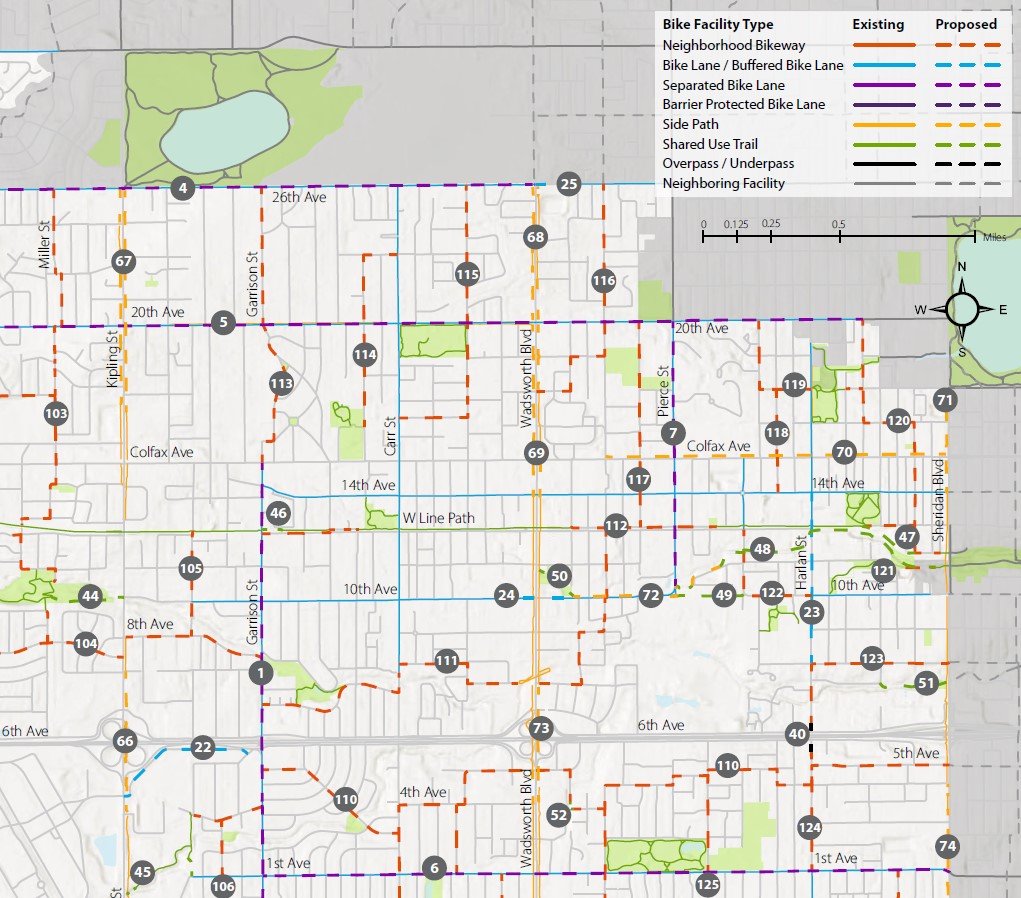
Two specific goals of the 2025 Bicycle Plan update were to 1) refine facility terminology for consistency and clarity and 2) incorporate new facility types that were not previously proposed in the 2018 Bicycle System Master Plan. The resulting proposed facility toolbox provides updated definitions and minimum design standards for seven different facility types: neighborhood bikeways, bike lanes, buffered bike lanes, separated bike lanes, barrier protected bike lanes, side paths, and shared use trails.
The proposed bicycle network was developed by building upon existing bicycle routes, carrying forward recommendations from previous bicycle system master plans, analyzing connectivity between facilities and popular destinations, determining facility types based on AASHTO-recommended speed and volume thresholds, and incorporating community feedback. To guide future implementation, the 163 recommendations in the resulting project list were scored using a prioritization framework that incorporates measures of connectivity, demand, and equity for each specific project.
Despite being completed entirely in-house with no dedicated budget, the 2025 Lakewood Bicycle Plan provides a valuable framework to guide the placement and design of bicycle facilities during ongoing City processes including development, annual repaving, and other infrastructure projects, while also representing political and community support for future project funding. The updated Plan sets Lakewood up for success and reflects the City's commitment to the environmental and health benefits of a safe, comfortable, and connected multimodal transportation network.
The adopted Bicycle Plan can be viewed and downloaded at www.Lakewood.org/Bicycling.